






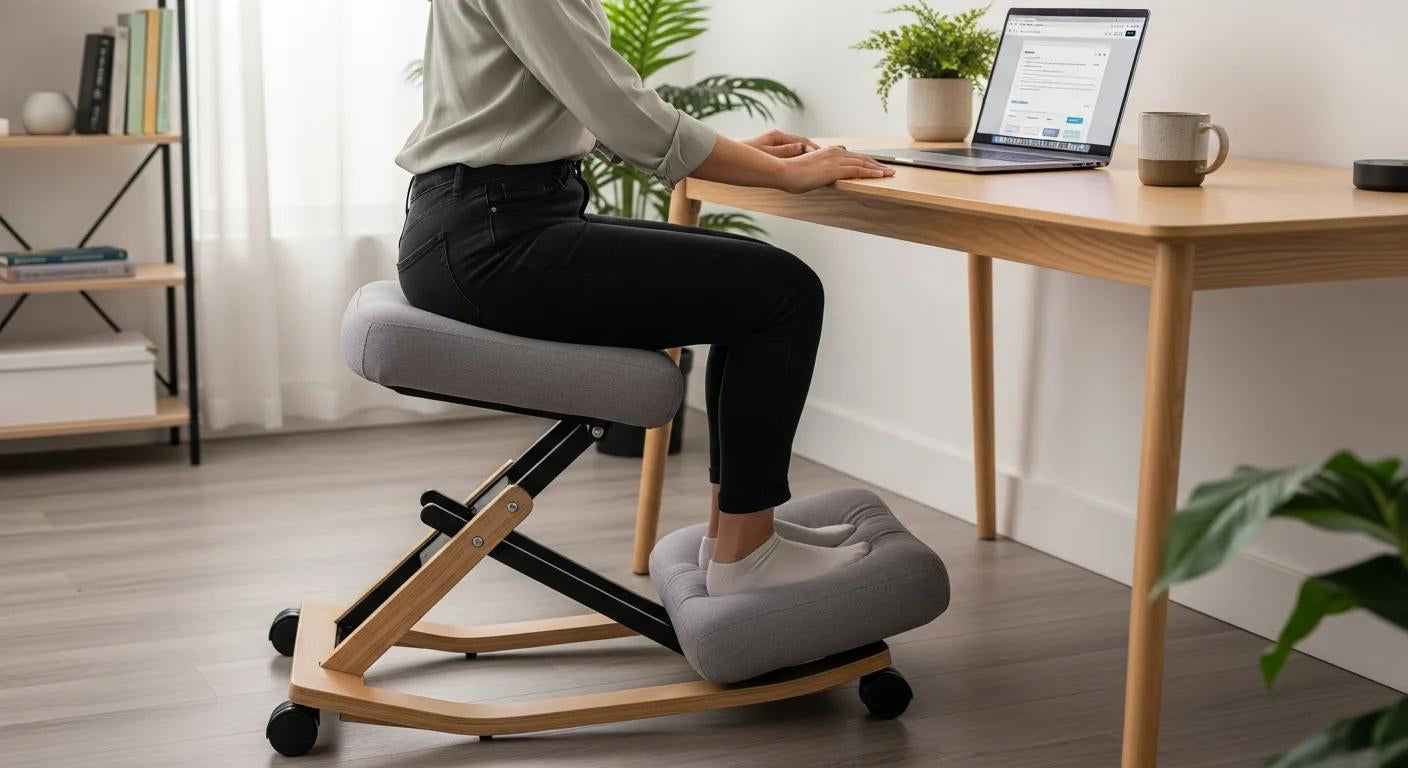
Elevate comfort and focus with kneeling chairs
Kneeling chairs are purpose-built ergonomic seats that tilt the pelvis forward and open the hip angle, pairing a seat pan with a knee pad to encourage active sitting and a naturally aligned spine. Let's explore how kneeling chairs work — pelvic tilt, weight sharing between seat and shins, and subtle micro‑movements — and explain how those mechanics can reduce lumbar compression and help you stay focused. You'll discover the ergonomic principles, how kneeling chairs can ease back pain, and how better circulation and comfort can improve concentration for office tasks. We'll also share practical tips for transitioning, recommended usage, and how to introduce kneeling chairs safely into workplace wellness programmes. Finally, we'll compare them with conventional office chairs and mention Terra Wellness's ergonomic kneeling chair options for businesses planning fit-outs. Understanding how they work makes it easier for organisations and individuals to choose seating that supports posture, reduces discomfort and boosts productivity.
What are the key ergonomic principles behind kneeling chairs?
A kneeling chair repositions the pelvis with a forward‑tilted seat and shin support, creating an open hip angle that helps the spine keep its natural S‑curve and reduces posterior pelvic tilt. The main design actions are pelvic tilt and seat angle, redistribution of body weight between the seat and shins, and encouragement of active sitting through micro‑movements. Together, these effects lower pressure on lumbar discs and discourage slouching. Our kneeling chairs achieve this with a seat pan, knee pad, tilt mechanism and supportive frame. The sections that follow outline how the chair promotes spinal alignment and how weight distribution works, which is why many people find relief from lower‑back strain when they use one correctly over time.
How does the design promote natural spinal alignment?
The tilted seat on a kneeling chair encourages an anterior pelvic tilt that restores lumbar lordosis, so the lower spine keeps its natural curve instead of flattening during long periods of sitting. By opening the hip angle (commonly around 110–120 degrees), the pelvis supports the lumbar region and reduces thoracic rounding and slouching. Practically, this places the erector spinae and the deep core muscles in a more neutral range, supporting your spine and helping you maintain good posture. Better spinal alignment also eases the compensatory neck and shoulder strain that often comes from conventional chairs, and it sets the scene for how redistributed weight lowers lumbar disc pressure.
In what ways does weight distribution reduce lumbar pressure?
Kneeling chairs shift part of your body weight from your sit bones to the shins and front of the thighs, sharing the load so compressive forces on lumbar intervertebral discs are reduced. Moving some weight onto the knee pad lessens pressure on your lower back, which can lead to noticeable reductions in lower‑back discomfort during seated work. This shift also changes how your muscles engage — hip flexors, gluteals and abdominals engage differently — reducing continuous strain on your lower back and allowing for short recovery periods. These mechanical changes reduce sustained compressive stress on the lower back and support improved comfort when the chair is used correctly and in moderation.
How do kneeling chairs improve physical comfort and alleviate back pain?
Kneeling chairs combine postural correction with active sitting to reduce static loading and encourage small movements, which together lower musculoskeletal strain and perceived pain. Key mechanisms are reduced lumbar pressure through weight redistribution, improved spinal alignment via pelvic tilt, and increased core engagement from balancing — all of which reduce posture‑related discomfort. Varied seating that allows movement supports circulation and reduces stiffness; using a kneeling chair as part of a broader seating strategy can therefore help. The practical guidance and table below explain how specific back complaints can benefit from these mechanical effects.
The following table summarises common conditions, how kneeling chairs act on them, and the benefits you can expect:
| Condition | Mechanism | Expected Benefit |
|---|---|---|
| Lower lumbar disc compression | Weight redistribution to shins + pelvic tilt | Lower intradiscal pressure and reduced lower‑back pain |
| Slouch‑related thoracic strain | An open hip angle maintains the lumbar curve | Fewer forward‑head and shoulder compensations |
| Muscle fatigue from static sitting | Micro‑movements and active sitting | Improved circulation and less stiffness |
Can kneeling chairs help reduce common office‑related back pain?
Kneeling chairs can ease common office issues like lower‑back strain, thoracic discomfort from slouching, and stiffness caused by prolonged stillness by altering load patterns and encouraging frequent small postural corrections. Many users experience fewer acute low‑back episodes because continuous compressive stress is reduced, and muscles get intermittent recovery through small adjustments. Set realistic expectations: most people need a short adaptation period (days to weeks), and kneeling chairs work best as part of a varied‑seating routine rather than as the only seat for an eight‑hour day. Transition guidance — short sessions mixed with conventional seating and complementary stretches — helps both employers and individuals get consistent benefits.
How does active sitting strengthen core muscles for long‑term support?
Active sitting on a kneeling chair produces continual small muscle activations — micro‑movements — that engage the deep trunk stabilisers such as the transverse abdominis and multifidus, improving your body's natural control over time. That sustained, low‑level engagement gradually builds core support, helping posture both during and away from sitting as your body adopts more efficient patterns. You may notice modest gains in stability and endurance with regular use, and even clearer benefits over time when combined with targeted core exercises. To maximise long‑term gains, alternate kneeling sessions with standing breaks and simple daily core routines.
In what ways do kneeling chairs enhance mental focus and concentration?
Kneeling chairs can improve focus by reducing physical distractions — discomfort, frequent posture changes and stiffness — that break cognitive flow, while active sitting and better circulation support alertness and sustained attention. More micro‑movement improves local blood flow and oxygen delivery, supporting your brain and lowering fatigue during demanding mental tasks. Comfortable seating also lowers the mental load of managing pain, freeing attention for the work itself and supporting productivity measures like task completion and fewer errors. The sections below outline circulatory mechanisms and practical reasons why comfortable seating helps maintain deep work sessions.
How does improved blood circulation boost cognitive function?
Micro‑movements from active sitting enhance circulation in your muscles, which supports circulation and helps maintain steady oxygen flow to your brain during long tasks. Better circulation delays stiffness and local fatigue that contribute to fatigue and lapses in attention, helping you sustain cognitive performance. Even small increases in movement‑driven blood flow assist glucose and oxygen delivery to the brain, supporting quicker processing and fewer attention slips during complex work. This suggests that seating that promotes movement can be a simple way to support your daytime cognitive function.
With circulation benefits in mind, it’s useful to consider how overall seating comfort reduces distractions and supports longer focus periods.
Why does comfortable seating sustain prolonged concentration?
Comfortable seating sustains concentration by cutting the pain signals and postural adjustments that fragment attention. When physical discomfort is lower, people report longer uninterrupted work blocks and better subjective focus, and these changes often link with productivity improvements in many workplaces. Practical tips to get the most from kneeling chairs include alternating them with conventional seats on a schedule, using them for focused tasks like writing or analysis, and monitoring perceived exertion to avoid overuse. With these habits, employers can track outcomes — time on task, output quality — alongside wellbeing measures to understand the benefits.
For employers interested in measuring productivity impact, Terra Wellness offers an Ergonomic Kneeling Chair in our Ergonomic Accessories range and can discuss trial options and procurement for fit‑out projects with workplace teams looking for effective seating solutions.
How can kneeling chairs be integrated into commercial fit‑outs for workplace wellness?
Adding kneeling chairs to a commercial fit‑out starts with an ergonomic audit to identify roles and tasks that will benefit most, followed by trial deployments, staff training and phased procurement to scale successful outcomes. The fit‑out process links product features — adjustable height, tilt range, padding density — to practical deliverables such as workstation compatibility, user education and rotation schedules that ease adaptation. Cost‑benefit thinking typically includes reduced discomfort‑related downtime, fewer short‑term absences and potential productivity gains from improved focus; useful metrics are staff satisfaction, time‑on‑task and absenteeism. The table below maps product features to recommended office use cases to guide specification.
| Chair Model Feature | Adjustable Feature | Recommended Office Use-Case |
|---|---|---|
| Seat pan tilt | Variable forward angle | Focused desk tasks and creative work |
| Knee pad cushion | High-density padding | Short‑to‑moderate duration sessions (2–3 hours) |
| Height adjustability | Range for varied anthropometry | Shared workstations and hot‑desking |
What are the benefits of ergonomic seating solutions for employee productivity?
Ergonomic seating reduces musculoskeletal complaints, supports circulation and attention, and contributes to improved well-being measures that correlate with productivity and staff retention. Employers tracking key performance indicators such as absenteeism, task completion and employee satisfaction often see positive shifts after introducing varied ergonomic seating and training. Useful metrics include self‑reported discomfort, MSD‑related sick days and productivity indicators relevant to your organisation; these insights help build a business case for investing in ergonomic accessories. Turning outcomes into procurement decisions requires well‑designed trials and ongoing staff feedback.
How does Terra Wellness support commercial clients with kneeling chair solutions?
Terra Wellness is an Australian e‑commerce wellness provider offering an Ergonomic Kneeling Chair in our Ergonomic Accessories category and supporting commercial clients with solutions tailored to workplace wellbeing initiatives. Our commercial support covers product selection to match tasks, supplying trial quantities for pilot programmes, and advising on phased procurement and staff orientation to ensure safe, effective adoption. Employers specifying kneeling chairs for fit‑outs can talk with us about model options, workstation compatibility, recommended rotation schedules and practical adaptation tips to overcome common barriers to uptake.
This commercial support follows the audit → trial → procurement → training cycle described earlier and helps teams implement ergonomic seating that delivers measurable workplace comfort outcomes.
What are the comparative advantages of kneeling chairs over traditional office chairs?
Kneeling chairs differ from traditional office chairs by prioritising pelvic tilt and active sitting rather than relying on lumbar cushions and recline, producing distinct effects on posture, lumbar pressure and core engagement. Compared with conventional seating, kneeling chairs often give quicker improvements in spinal alignment and greater core activation, while traditional chairs can be more comfortable for long, low‑movement tasks thanks to adjustable lumbar support and armrests. Use‑case guidance helps decide when a kneeling chair is the better choice — for focused work and posture retraining — versus when a conventional chair is preferable for long collaborative sessions or tasks needing arm support. The comparison table below summarises these trade‑offs across key attributes.
| Attribute | Kneeling Chair | Traditional Office Chair |
|---|---|---|
| Posture support | Promotes natural lumbar curve through pelvic tilt | Supports lumbar via external cushioning and recline |
| Lumbar pressure | Reduces intradiscal compression through weight redistribution | May increase static lumbar load if posture collapses |
| Core engagement | Encourages active micro‑movements and core activation | Often passive support, less core engagement |
| Suitability for long hours | Best used in rotation with other seating | Better suited for continuous long‑duration sitting |
How do kneeling chairs improve posture compared to conventional seating?
Kneeling chairs improve posture by mechanically tipping the pelvis forward, which helps sustain lumbar lordosis and reduces thoracic rounding that leads to forward‑head posture. By contrast, many conventional chairs rely on backrest contours and lumbar pads that can allow slumping if the user becomes passive. Practical tips: set seat height so hips sit slightly above knees, adjust the tilt until you achieve an open hip angle, and alternate use with a conventional chair to avoid localised pressure. These simple adjustments help you gain the postural benefits while minimising overuse.
What are the potential drawbacks, and how can they be mitigated?
Common limitations include initial knee or shin discomfort, reduced arm support for repetitive mouse and keyboard tasks, and unsuitability for an uninterrupted eight‑hour day without rotation. Mitigations include padded knee supports, intermittent use combined with an ergonomic chair, scheduled standing breaks, and staff education on posture and session length. Employers can roll out gradual introduction plans — 15–30 minute sessions that increase over weeks — and provide complementary accessories to accommodate different body types. These measures lower adoption barriers and make kneeling chairs a practical part of a mixed‑seating approach.
How does using a kneeling chair contribute to overall workplace wellness strategies?
Kneeling chairs support workplace wellness by addressing ergonomic risk factors linked to musculoskeletal disorders (MSDs), encouraging active sitting and fitting into broader injury‑prevention and hybrid‑work policies. As one element of a wellness programme, kneeling chairs sit alongside training, movement breaks, adjustable workstations and hybrid deployment policies that give employees choice. Continuous improvement — regular feedback, discomfort surveys and KPI tracking — ensures the strategy adapts to staff needs and role requirements. The table below links ergonomic chair roles to wellness deliverables to help programme managers plan.
| Wellness Element | Role of Ergonomic Chairs | Recommended Measurement |
|---|---|---|
| MSD prevention | Reduce sustained loading and improve posture | Self‑reported pain scores, incident rates |
| Employee choice | Offer seating alternatives for different tasks | Usage logs, satisfaction surveys |
| Hybrid policy support | Facilitate home/office compatibility with portable options | Uptake rates, feedback loops |
What role do ergonomic chairs play in reducing musculoskeletal disorders?
Ergonomic chairs help reduce MSD risk by lowering static loading, encouraging neutral postures and supporting movement patterns that keep your tissues healthy and muscles working well. Experts often recommend varied seating and task rotation to prevent repetitive strain and cumulative load injuries; kneeling chairs provide a helpful alternative posture that can reduce several common risk factors for lower‑back complaints. Employers should combine chair deployment with monitoring — regular ergonomic assessments and employee‑reported outcomes — to see the positive impact and identify if other support is needed. This feedback loop ties seating choices to workplace health objectives.
How do kneeling chairs fit into hybrid work environments?
In hybrid models, kneeling chairs can be offered selectively — in focused zones at the office or as optional equipment for staff who prefer active sitting — while home‑office advice should emphasise portability and ergonomic training. Practical policies include loan programmes for trials, clear hot‑desking rules that note compatible furniture, and feedback channels for comfort or fit issues. A flexible approach that pairs office kneeling chairs with adjustable home seating supports employee choice and keeps the benefits of varied seating across locations. Simple trial‑and‑feedback loops in hybrid settings help refine allocation and improve adoption.
This article has explored how kneeling chairs support office comfort, posture and focus, plus practical steps for integrating them into fit‑outs and broader workplace wellness strategies. By prioritising pelvic alignment, weight redistribution and active sitting, kneeling chairs offer a useful option within a mixed‑seating programme that supports individual wellbeing and organisational productivity.