





Elevate Meal Prep with Titanium Cutting Boards
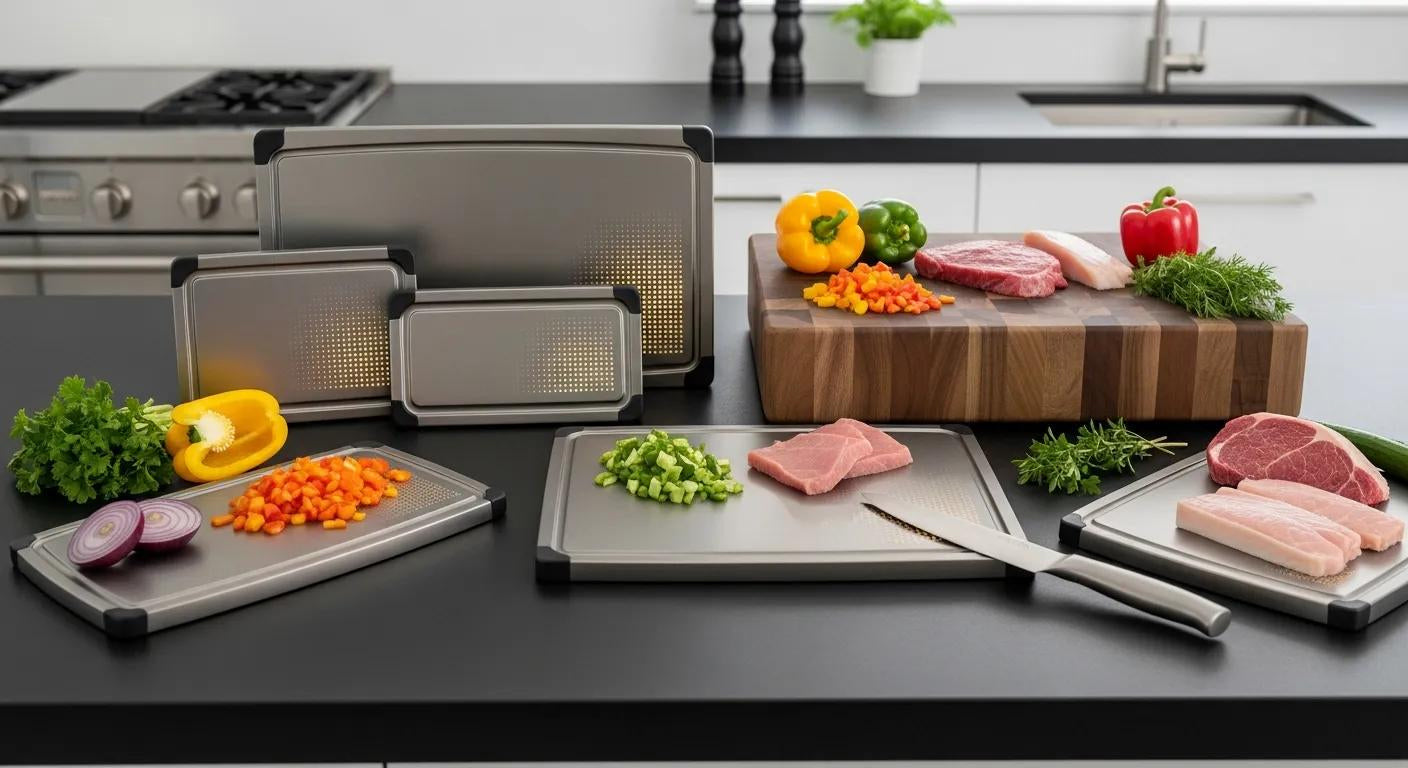
At Terra Wellness, we recommend titanium cutting boards when hygiene, longevity, and low environmental impact matter most. Made from solid titanium or titanium-clad materials, these non-porous surfaces combine strong, easy-to-clean performance with incredible resilience for both home cooks and busy commercial kitchens. We'll explore how a non-porous titanium surface lowers bacterial risk, why titanium resists warping and staining, how it interacts with your knives, and the environmental and health advantages of choosing metal over conventional plastic or wooden boards. If you're concerned about cross-contamination, microplastic shedding from plastic boards, and the constant need for replacements, titanium addresses those worries while also making your kitchen workflow smoother.
We'll answer your practical questions about hygiene, durability, blade care, environmental impact, and how titanium stacks up against other materials, helping you decide if it's the right fit for your kitchen.
Why Are Titanium Cutting Boards Considered Hygienic for Meal Preparation?
Titanium cutting boards are favoured for hygiene because their continuous, non-porous metal surface leaves nowhere for bacteria to hide. This makes sanitisation more reliable and reduces biofilm formation compared with porous materials. The science is simple: titanium presents an inert surface that naturally discourages bacteria from sticking, making them easy to wash away with routine cleaning. This means a lower risk of cross-contamination between raw and cooked foods – a huge plus for any kitchen. Non-porous surfaces consistently retain fewer bacteria after standard cleaning cycles than scratched plastic or untreated wood. With these hygiene benefits in mind, let's take a closer look at how titanium’s surface behaves and the best ways to keep it sparkling clean and safe.
In practical terms, titanium cutting boards offer three clear hygiene advantages:
- Their smooth, non-porous finish removes microhabitats where bacteria can lodge, meaning fewer germs after washing.
- Titanium handles standard disinfectants and high-temperature cleaning better than many plastics, supporting effective sanitisation routines.
- Smooth metal surfaces are less prone to biofilm formation, which simplifies routine surface testing.
These points show why titanium is a fantastic choice for meal prep. Now, let's dive into how its surface works and the best cleaning tips.
How Does a Non-Porous Titanium Surface Prevent Bacterial Growth?
A non-porous titanium surface stops bacterial growth by eliminating the tiny pores and cracks where microbes love to colonise. Without those niches, bacteria stay exposed on the surface and are easily removed by routine cleaning. The naturally formed oxide layer on titanium also makes it harder for many foodborne bacteria to stick, preventing the attachment process that leads to biofilm. In simple terms, switching from a scratched plastic or untreated wooden board to titanium usually means fewer bacteria remain after just one wash — a big win when you're prepping raw and cooked foods. For example, preparing raw chicken on a clean titanium board and following a proper wash step with detergent and hot water reduces the risk of transferring contamination to salad ingredients compared with using a porous board. This practical benefit leads us to the best cleaning routines to keep your titanium board hygienic without damaging its finish.
Next, we'll share the best cleaning steps and disinfectants for titanium, whether you're cooking at home or in a busy kitchen.
What Cleaning Methods Ensure Titanium Cutting Boards Remain Safe and Sterile?
For daily use, start by scraping or rinsing away loose debris, then wash with hot water and detergent, rinse thoroughly, and dry. This basic routine removes the bulk of soil and reduces microbial load effectively. For a deeper clean, especially in busy kitchens, use disinfectants approved for metal surfaces, following the instructions carefully. Common choices include quaternary ammonium compounds or chlorine-based sanitisers, always with a rinse if needed. Many titanium boards are dishwasher-safe when used within the manufacturer’s temperature and detergent guidelines; high-temperature cycles and chemical sanitisation further reduce microbial presence without degrading the surface. Avoid aggressive, abrasive pads that can scratch and roughen the finish over time; instead, use gentle scouring pads or non-abrasive cloths to preserve the board’s non-porous character and prolong its hygienic performance.
Following these simple routines helps ensure your board stays hygienic and performs brilliantly for years to come.
How Does Titanium Enhance Durability Compared to Wood and Plastic Cutting Boards?
Titanium improves durability through its mechanical strength, corrosion resistance, and a stable oxide layer that resists the common failure modes of wood and plastic — warping, cracking, deep gouging, and persistent staining. Boards that keep their shape and surface integrity need fewer replacements, lower maintenance, and retain hygienic performance longer than porous or brittle alternatives. For busy kitchens, this means less hassle, fewer replacements, and a consistently high standard of cleanliness throughout the board’s long life.
How materials compare across porosity, stain resistance, warp resistance, and expected lifespan:
| Material | Porosity | Stain Resistance | Warp/Crack Resistance | Expected Lifespan |
|---|---|---|---|---|
| Titanium | Non-porous | High | Very high | Very long (many years) |
| Wood | Porous | Medium (absorbs stains) | Medium (susceptible to warping) | Medium (months to a few years) |
| Plastic (HDPE) | Low–medium | Medium (scratches, stain) | Medium (can warp under heat) | Short to medium (months to a few years) |
| Stainless steel | Non-porous | High | High (may dent) | Long (years) |
This comparison clearly shows how titanium keeps its surface integrity even with heavy use, making it a smart choice for sustainability and reducing everyday kitchen frustrations.
What Makes Titanium Cutting Boards Resistant to Warping, Cracking, and Stains?
Titanium resists warping and cracking because of its high strength-to-weight ratio, stable crystal structure, and the naturally formed titanium oxide layer that protects against corrosion and surface breakdown. That oxide layer is chemically inert, so it resists staining and odour absorption better than organic materials and some polymers that retain oils and pigments. Unlike wood, titanium doesn’t swell or shrink with moisture cycles; unlike many plastics, it tolerates temperature changes without permanent deformation. Together, these traits keep the surface smooth and continuous even after repeated knife impact and cleaning cycles, making titanium a practical choice where reliability and low maintenance matter.
Because these properties mean a much longer usable life, the next section explores the sustainability and long-term benefits that make titanium a smart choice for both home cooks and commercial kitchens.
How Does the Longevity of Titanium Boards Contribute to Sustainable Kitchen Practices?
A longer service life reduces material throughput: fewer boards produced, transported, and disposed of over time lowers embedded environmental impacts and landfill contribution versus frequently replaced plastic boards. Titanium does not shed microplastics during cutting or washing, removing a known contamination pathway that contributes to environmental and dietary microplastic exposure. From a long-term value perspective, needing fewer replacements means more efficient use of resources and can lead to overall savings over time, making titanium a smart choice for anyone prioritising sustainability. This makes titanium a great fit for sustainable practices that focus on reducing waste and choosing materials with strong reuse or recycling potential.
These long-term benefits naturally lead to questions about how titanium interacts with your knives – specifically, whether it affects blade edges and how to keep them sharp. Let's dive in.
Are Titanium Cutting Boards Knife-Friendly and How Do They Protect Blade Sharpness?
Titanium cutting boards are generally knife-friendly because the surface hardness of titanium alloys used for boards is typically lower than that of many high-hardness knife steels, which reduces abrasive wear on edges. The smooth metal surface also helps prevent catching and micro-chipping. Since most kitchen knife steels are harder than the titanium surface, you'll experience predictable, gradual dulling that's easily managed with regular honing and sharpening, rather than sudden damage. Based on that understanding, we recommend simple maintenance and cutting techniques to maximise blade life when working on titanium surfaces.
- Hone regularly: run a honing rod before each prep session to realign the edge.
- Sharpen at the right intervals: send knives for professional sharpening when performance drops rather than waiting for major wear.
- Use proper technique: avoid twisting or prying motions that stress the edge; prefer straight-down or rocking cuts.
These practices are straightforward and help keep both blades and boards performing reliably.
Why Is Titanium Softer Than Most Knife Steels and What Does This Mean for Knives?
Titanium alloys used for kitchen surfaces typically measure lower on hardness scales than high-carbon or hardened stainless knife steels. This means your board is less likely to chip or damage a good-quality blade; instead, your knives will experience gradual edge dulling that you can easily manage with regular maintenance. In short, expect routine sharpening rather than catastrophic failure, and protect edges through correct cutting angles and a maintenance schedule that fits your usage intensity. This balance allows you to pair your board choice with a blade-care routine for consistent cutting performance over many years.
What Are the Best Practices for Maintaining Knives When Using Titanium Boards?
Adopt a consistent knife-care routine: hone daily to correct micro-bending, sharpen on a whetstone or by a professional when the edge geometry degrades, and store blades so they don’t contact other metal that can cause nicks. Use cutting motions that reduce lateral stress — slice with forward and downward motion rather than levering or twisting — to preserve both blade geometry and the board surface. Regularly check your blade's condition and consider professional sharpening when needed, especially in busy kitchens, to ensure clean, precise cuts every time. These measures, combined with the durability of titanium boards, create a predictable system for blade life and hygiene.
What Environmental and Health Benefits Do Titanium Cutting Boards Offer?
Titanium cutting boards offer environmental and health advantages by eliminating microplastic shedding, providing an inert surface that resists odours and leachable chemicals, and reducing replacement frequency compared with plastic alternatives. Metals do not fragment into polymeric microplastics under normal cutting and cleaning conditions, so choosing a non-plastic surface removes a known pathway for environmental and dietary contamination. Health benefits also include reduced persistent odour retention and a lower need for harsh cleaners because the surface is easier to sanitise. Combined, these features make titanium an attractive option for kitchens focused on product purity and sustainability.
How Do Titanium Boards Eliminate Microplastic Contamination Risks?
Titanium eliminates microplastic contamination risks because, as a metal, it does not shed polymer particles when cut, abraded, or washed — unlike degraded plastic boards that can release microplastics through repeated scoring and dishwasher cycles. By choosing non-plastic surfaces for direct food contact, you completely remove one source of particulate contamination – a crucial step for allergen control and maintaining food integrity. Practical steps include choosing metal surfaces for direct food contact and looking after your cutting surfaces to avoid unnecessary abrasion.
Why Are Titanium Cutting Boards Considered an Eco-Friendly Kitchen Choice?
Titanium is often viewed as more eco-friendly than frequently replaced plastics because its long lifespan reduces manufacturing demand and waste, and because its recyclability and inertness lower long-term environmental liabilities. When you consider the overall value and material usage, titanium’s durability and resistance to degradation mean fewer replacements and less waste over time. Choosing titanium for busy kitchen areas can be part of a broader sustainability approach that favours fewer single-use materials and less need for harsh cleaning chemicals. For you, that means weighing the upfront cost against reduced running costs and environmental impacts over the board’s long service life.
How Do Titanium Cutting Boards Meet Commercial Kitchen Hygiene and Safety Standards?
Titanium cutting boards are a fantastic choice for commercial kitchens, offering non-porous, easily sanitised surfaces that fit seamlessly into food safety plans, simplify routine checks, and reduce biofilm risk where it matters most. In practice, a reliably clean surface makes food safety measures at raw-prep and cook-line stations easier to manage and monitor. For kitchen managers, this means better traceability and fewer sanitation issues during inspections, as titanium reduces the problems often associated with porous or degraded boards. The points below highlight how titanium fits into formal food safety systems and supports documented cleaning routines and verification.
Key attributes of titanium for food safety include:
- Non-porous surface: Limits places for microbes to hide and makes hygiene checks simpler.
- Chemical and thermal tolerance: Accepts standard disinfectants and high-temp cleaning cycles.
- Dimensional stability: Keeps the surface intact, so cleaning effectiveness doesn't drop over time.
What Are the Food Safety Advantages of Titanium in Commercial Meal Prep?
Titanium offers several food safety benefits for commercial meal prep: it reduces cross-contamination risk at raw-prep stations, works perfectly with fast sanitisation cycles, and provides reliable results for hygiene checks during audits. Because titanium handles high-temperature washes and compatible disinfectants, kitchen teams can use their usual chemical and heat-based cleaning routines without worrying about the surface degrading and compromising hygiene. This predictability simplifies food safety documentation – your control measures and monitoring remain valid throughout the board's lifetime – and reduces the need for corrective actions due to surface issues. The result is more reliable operations and lower inspection risk in busy kitchens.
How Does Terra Wellness Leverage Titanium Expertise in Commercial Fit-Out Projects?
Terra Wellness uses its material expertise to help with commercial kitchen fit-outs, advising on choices that balance hygiene, durability, and long-term value. We coordinate everything from design to installation, ensuring titanium is used where it makes the biggest difference. Typically, our projects result in stricter cleaning routines, fewer surface replacements, and clearer food safety documentation, because we ensure material selection perfectly matches your kitchen's operational needs. If you're looking to introduce advanced materials, you can work with Terra Wellness to explore suitable titanium applications and integrate them into your kitchen layout, always keeping hygiene and safety as top priorities. To discuss your commercial project, simply contact Terra Wellness for tailored advice on specifications, sourcing, and installation.
How Do Titanium Cutting Boards Compare to Wood, Plastic, and Stainless Steel Alternatives?
Titanium stacks up really well against wood, plastic, and stainless steel when it comes to hygiene, durability, how it treats your knives, maintenance, lifespan, and environmental impact. The best choice for you will depend on how you plan to use it, how often, and what your hygiene priorities are. Broadly, titanium and stainless steel are non-porous and highly sanitizable; wood has some natural antimicrobial properties but is porous and requires more care; and plastic is inexpensive but can accumulate scratches and release microplastics.
A look at long-term considerations (relative indicators):
| Material | Upfront Cost | Replacement Frequency (over time) | Maintenance Effort | Environmental Impact |
|---|---|---|---|---|
| Titanium | Higher | Very low | Low | Low (recyclable/inert) |
| Stainless steel | Medium–high | Low | Medium | Low (recyclable) |
| Wood | Low–medium | Medium | Medium–high | Medium (biodegradable but frequent discard) |
| Plastic (HDPE) | Lower | High | Medium | High (microplastic risk, landfill) |
This table shows that while the upfront cost might be a bit higher, titanium can offer significant long-term value by reducing the need for frequent replacements and minimising its environmental impact over time.
What Are the Key Differences in Hygiene and Durability Among Cutting Board Materials?
Differences in hygiene and durability come down mainly to porosity and surface stability: non-porous metals (titanium, stainless steel) are easiest to sanitise and resist biofilm; wood is porous and needs careful maintenance to avoid harbouring bacteria; plastic starts sanitary but develops surface scratches that increase contamination risk and microplastic shedding. In durability terms, metals resist warping and staining, wood can warp or crack with moisture cycles, and plastics can deform or score under heavy use. Maintenance reflects these realities: wood often needs oiling and repair, plastic requires replacement as scratches deepen, and titanium needs only routine cleaning to remain effective. These contrasts help determine the right material based on hygiene needs and usage intensity.
Choose titanium where consistent hygiene and rarely needing replacements are essential. Other materials might suit less frequent use or different budget considerations.
Which Cutting Board Material Offers the Best Long-Term Value for Meal Prep?
For long-term value in busy or commercial settings, titanium often comes out on top. Its extended lifespan, low maintenance, and reduced hygiene risks all contribute to overall efficiency and sustainability over time. For home cooks with light to moderate use, a quality wooden or thicker HDPE board can be a practical choice if the upfront cost is a key factor. However, for allergy-sensitive environments, commercial kitchens, or anyone focused on sustainability, titanium’s reduced long-term material use is incredibly appealing. When making your decision, it's smart to weigh the upfront cost against how often you'll need to replace it, how easy it is to keep clean, and your environmental goals. When you look at it this way, titanium often offers excellent long-term value for busy meal-prep environments.
- Use-case recommendation: Titanium for commercial/high-use stations and allergy-sensitive lines.
- Moderate-use recommendation: Stainless steel for durable, cost-effective setups.
- Home/light-use recommendation: Quality wood or thick HDPE for less frequent home use.
These recommendations summarise practical choices for anyone comparing materials based on hygiene, durability, how they interact with knives, and long-term value.