




Do Titanium Chopping Boards Dull Your Knives?
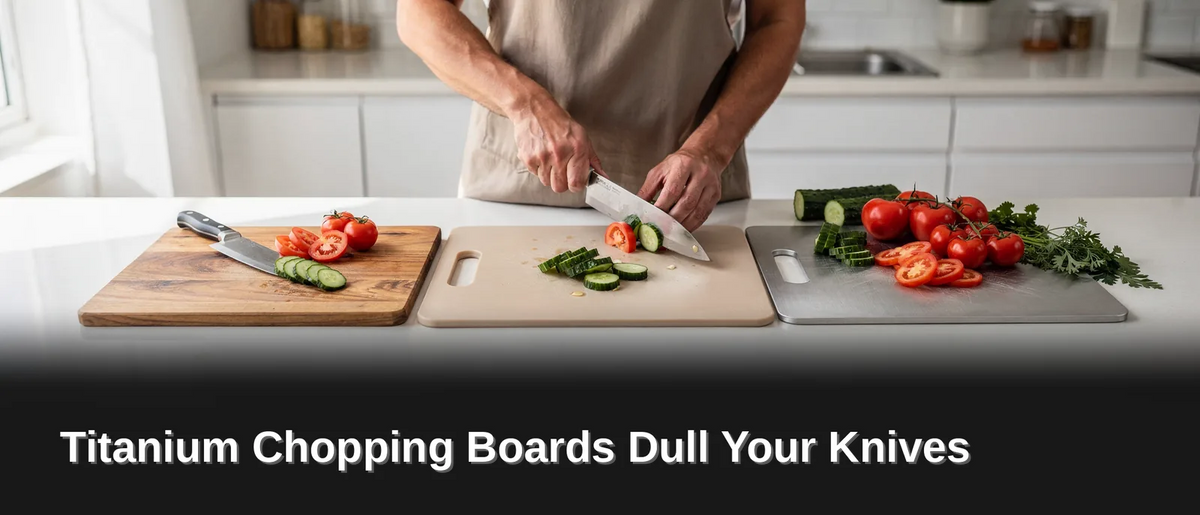
Titanium chopping boards dull knives faster than wood or plastic, since their hard, non-porous surface absorbs less impact during each cut.
Key Takeaways
Titanium cutting boards dull knife blades faster than softer materials like wood or plastic.
Hard surfaces like titanium cause blade edges to flatten and lose their sharp cutting ability.
Repeated contact between steel knives and titanium boards accelerates edge deterioration significantly over time.
Does a Titanium Board Really Dull Your Knives?
Yes, a titanium chopping board dulls knives faster than wood or plastic surfaces. The reason sits in the material itself, not in poor technique.
Timber flexes slightly under a blade. Plastic does too, absorbing some of the shock with every chop. A titanium cutting board offers the blade far less give, since its harder, non-porous surface absorbs less impact during cutting. That missing cushion means more force travels straight into the blade edge rather than being soaked up by the board.
Terra Wellness markets its Titanium Cutting Board as a durable, non-porous and easy-to-clean food-preparation surface. A harder metal surface behaves differently from timber or plastic and may require more frequent knife maintenance.
Does this mean titanium boards are bad for knife care?
Not necessarily. Faster edge wear is a trade-off, not a flaw, and it's manageable with consistent knife care habits. Home cooks who stay on top of maintenance can still enjoy the hygiene and durability benefits of a titanium surface.
How does blade dulling on titanium compare to wood?
Wood's softer surface cushions the blade with every stroke, so edges stay sharper for longer between sharpenings. Titanium offers less of that cushioning effect, meaning:
Edges dull sooner with regular use
Maintenance routines need to be more consistent
Technique and pressure matter more than on timber
Why Do Hard Boards Wear Blade Edges Faster?
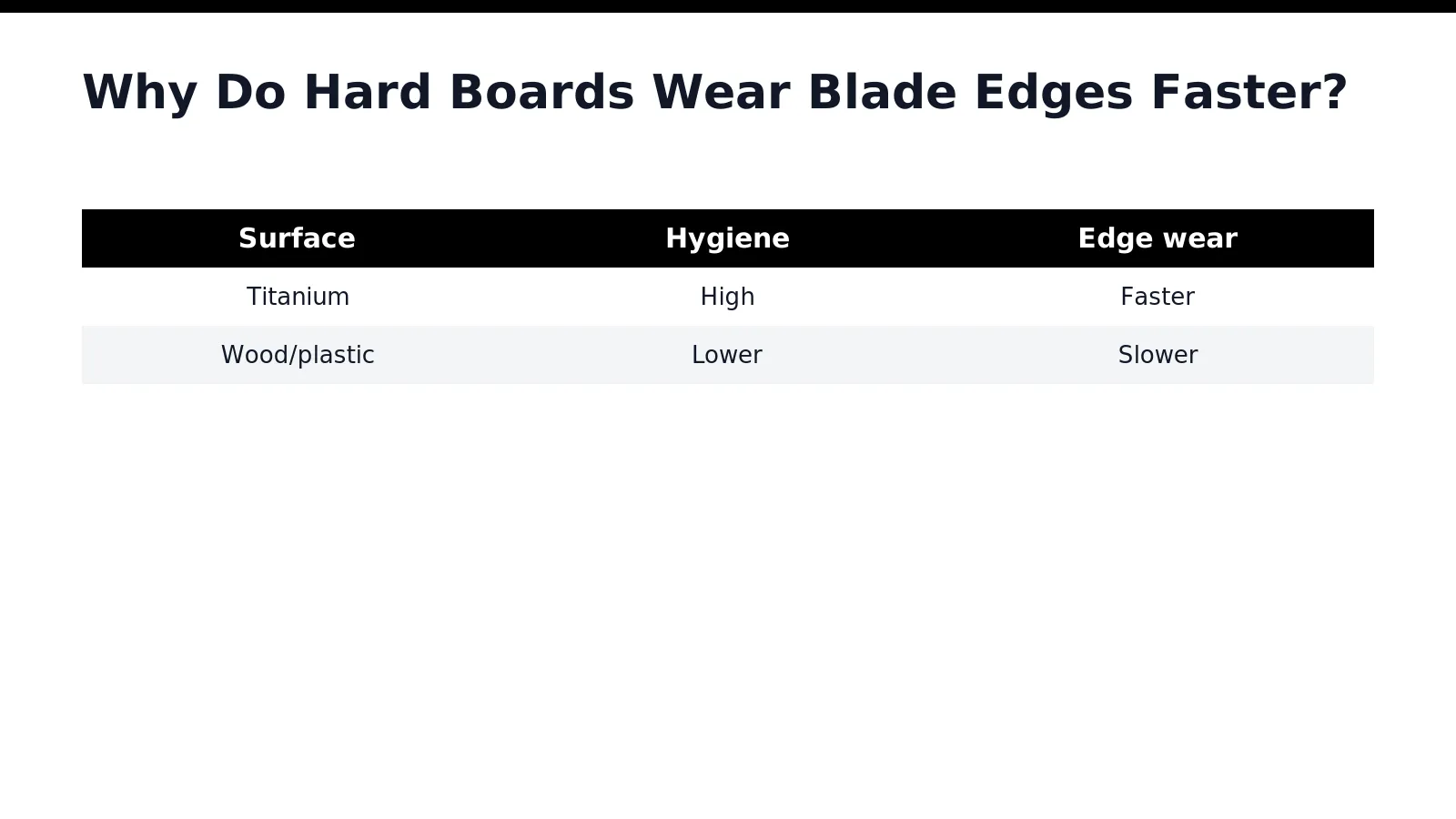
Hardness explains the trade-off. A titanium cutting board has less give than timber or plastic, so more of each cutting impact is transferred back to the blade edge. Over repeated use, that harder contact may mean more frequent honing or sharpening.
The non-porous quality that makes titanium so hygienic works against the knife in the same stroke. A surface that resists bacteria growth and extends the board's usable life gives the steel little cushioning on contact. The edge meets resistance instead of give. Critics of metal boards point to this exact trade-off, citing rapid dulling and microscopic blade damage as a genuine downside of harder surfaces.
Does that mean a titanium board ruins knives?
The board is marketed as non-porous and easy to clean, but those hygiene-focused features do not eliminate the normal edge-wear trade-off of a hard cutting surface. Regular honing and periodic sharpening may be needed.
Factor comparison:
| Surface | Cleaning characteristics | Effect on knife edges |
|---|---|---|
| Titanium | Non-porous and easy to rinse | Harder contact may require more frequent honing or sharpening |
| Wood or plastic | Care and hygiene depend on the material, condition and cleaning method | Softer surfaces are generally gentler on blade edges |
How Do You Keep Your Blade Edge Sharp?
Sharp knives start with the right board, not just the right sharpening routine. Size and thickness matter too, since a board that flexes or sits too thin under a blade changes how much impact the edge absorbs with every cut.
What size titanium board works best for home kitchens?
Terra Wellness offers S (29 × 20 cm), M (34 × 23 cm), L (39 × 28 cm) and XL (46 × 30 cm). Choose based on bench space and typical preparation tasks; the product page does not state a universal best size for knife care.
A titanium chopping board's sleek metallic surface isn't just visual polish. It delivers genuine functional performance in day-to-day cooking, but that performance depends on pairing the board with deliberate knife care.
Does honing really make a difference on titanium?
Routine honing between full sharpenings can help realign the blade edge, while sharpening removes metal to restore the cutting bevel. On a harder surface, check the edge regularly and maintain it when cutting performance declines.
FAQ
Does a titanium chopping board blunt your knives?
Yes, titanium chopping boards dull knives faster than wood or plastic. The hard, non-porous surface absorbs less impact during cutting, sending more force directly into the blade edge with every stroke.
What happens to a blade edge on a hard board?
Hard surfaces can make a blade edge roll, flatten or lose sharpness more quickly because the board absorbs less of the cutting impact.
Conclusion
Titanium chopping boards can offer a non-porous, easy-to-clean surface, but their hardness may dull knife edges faster than softer wood or plastic boards. The practical trade-off is straightforward: use controlled pressure, hone regularly and sharpen when needed.